Monte VI de E‑O
A Cogitation.
A Contemplation.
A Meditation.
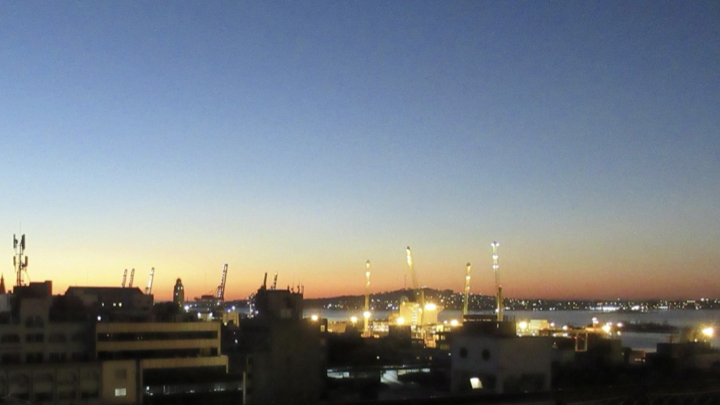
Inspired by summer-evening sunset views of el Puerto de Montevideo.
The Work
A video installation in a dark rectangular room with walls that support efficient audio (no earphones) and deter audio leakage.
Controlled access.
Twenty persons every 30 minutes.
All are free to leave anytime.
As the audience arrives, this video begins on the left wall and plays for 3.5 minutes.
Audio fades in easy.
Serious audio.
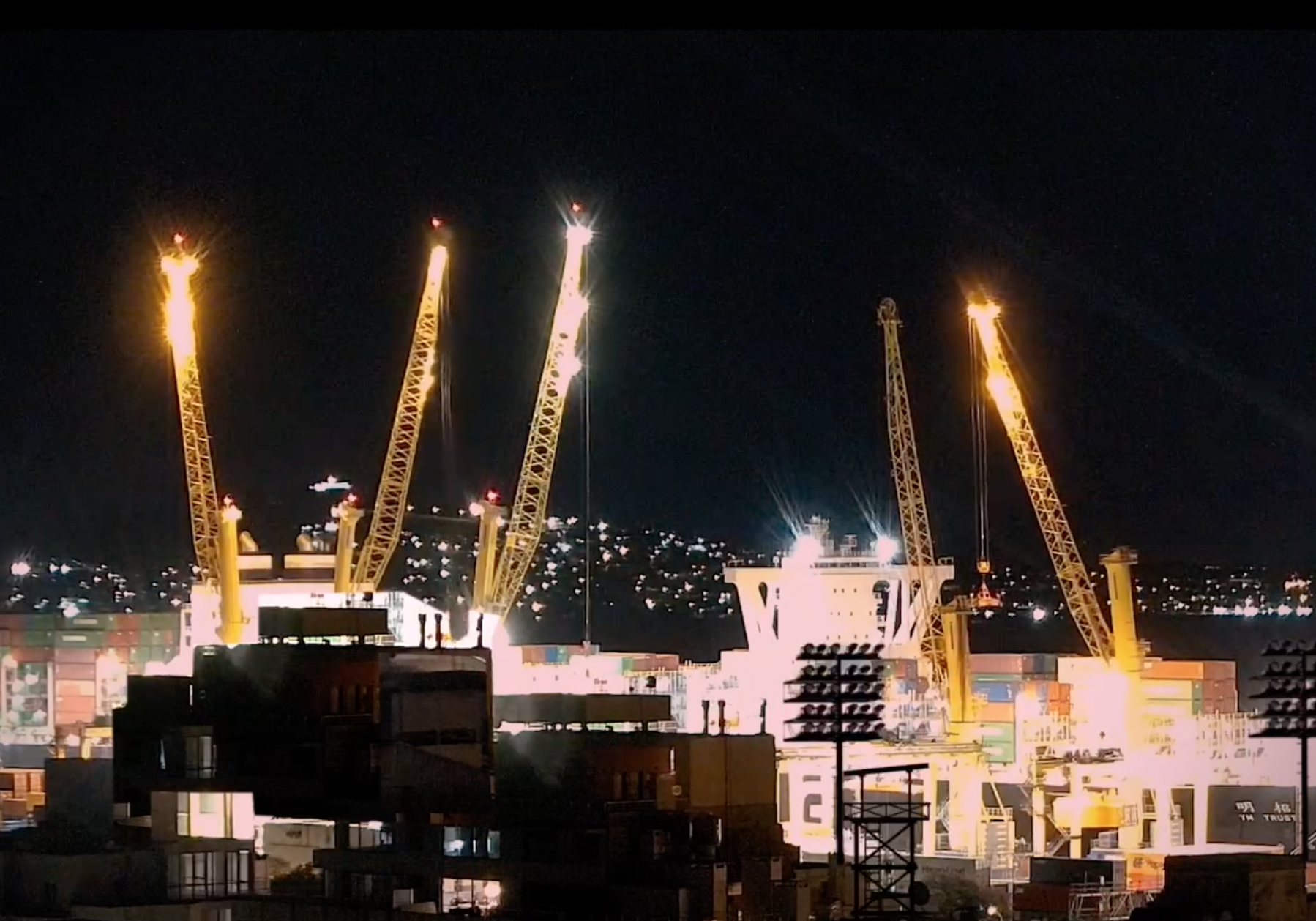
place holder for video
Then the video dissolves into a linear version that repeats the first video in a complex sequence and duplicates it.
Audio Continues
On the opposite wall:
Two large screens appear, side by side, as a recorded narrator begins a story.
Left screen:
Video visualization of recent international ship traffic.
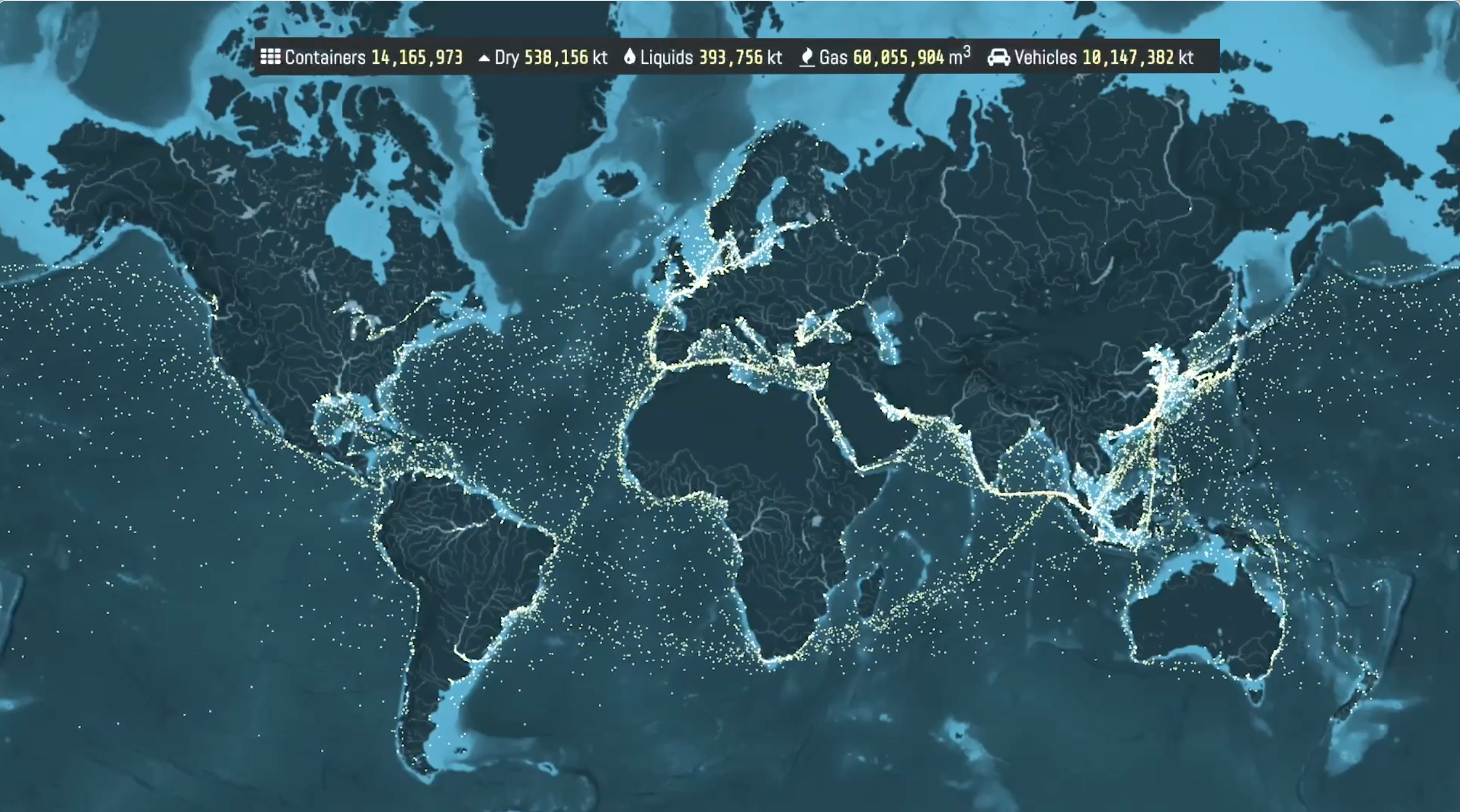
Right screen:
Slow flow of shipping and trade statistics. And true miniature stories about the industry. The credits appear on the data screen.
Puerto de Montevideo
22.15 UTC - 02:00, 18.04.2024
Facilities and operations: Katoen Natie
Ship: YM Trust
Owner: Yang Ming Marine Transport corporation.
Flag: Singapore
Contructed by: Higaki Shipbuilding,2021
Cargo Capacity: 14,000 containers.
Route: Round trip, Asia to South America
Location: Guru'Guay
The narration continues for 10 minutes. A West Indian matriarch describes the players in the scene, and explains why the scene exists:
We can’t live without it.
As the narration nears the end, the first screen returns to the original single port view.
The dancing cranes take their final bow.
The End
Requirements:
- Permission to use Spire Global’s shipping data for the world map
- Enclosed dark space, 15 x 15 meters
- Serious projector and digital screens
- Perfect audio
- Chairs or benches or pillows
- Easy simple entry system
- Financial and curatorial support
- Good people
- Specifications are negotiable, within reason.
- Budget to be determined by location and configuration.
Diagram of the Room
Narration
In 1726, Spain defeated Portuguese invaders and created el Puerto de Montevideo.
The official name was a Spanish navigation point. The sixth hill east to west, along a deep natural harbor.
Now the blinking beacon in the middle left of the video marks the hill.
Monte de VI de E a O
At first, Montevideo was a small village in Spain’s colonial empire. Soon it became a major international port for tycoons in Amsterdam, London, Lisbon, New York, and Seville.
It also welcomed thousands of Europeans and their African slaves. The Europeans overwhelmed and mostly eradicated the people who lived near the port and in the countryside. Eventually, after many battles and manoeuvres, the Europeans created a new nation.
República Oriental del Uruguay
Now, 300 years after the first ships unloaded there, el Puerto de Montevideo receives and exports enormous cargos of minerals, energy, food, wine, vehicles, and life’s essentials and luxuries, to and from the Americas, Europe, Asia, and beyond. It is a major link in the world’s industrial empires.

Katoen Natie was created in Antwerp in 1854, to receive and process cargos of cotton from Europe’s colonial empires.
In English, its name is: Cotton Guild.
En español: Asociación Algodonera.
It slowly expanded to manage imports of jute, coffee, cocoa, wool, rubber, and aluminium from Asia, Africa, the Middle East, and the Americas.
Now, 170 years after it processed its first shipment, Katoen Natie manages ports and trade in 36 countries.
It’s a major player in international logistics. It’s also a major player in international art. Its home office in Antwerp displays works from the company’s collection of 3000 classic and contemporary artworks and objects.
Senior executives work surrounded by art that others can see by appointment only.
Narration
In 1726, Spain defeated Portuguese invaders and created el Puerto de Montevideo.
The official name was a Spanish navigation point. The sixth hill east to west, along a deep natural harbor.
Now the blinking beacon in the middle left of the video marks the hill.
Monte de VI de E a O
At first, Montevideo was a small village in Spain’s colonial empire.
Soon it became a major international port for tycoons in Amsterdam, London, Lisbon, New York, and Seville.
It also welcomed thousands of Europeans and their African slaves.
The Europeans overwhelmed and mostly eradicated the people who lived near the port and in the countryside.
Eventually, after many battles and manoeuvres, the Europeans created a new nation.
República Oriental del Uruguay
Now, 300 years after the first ships unloaded there, el Puerto de Montevideo receives and exports
enormous cargos of minerals, energy, food, wine, vehicles, and life’s essentials and luxuries,
to and from the Americas, Europe, Asia, and beyond.
It is a major link in the world’s industrial empires.
Katoen Natie was created in Antwerp in 1854, to receive and process cargos of cotton
from Europe’s colonial empires.
In English, its name is: Cotton Guild.
En español: Asociación Algodonera.
It slowly expanded to manage imports of jute, coffee, cocoa, wool, rubber, and aluminium
from Asia, Africa, the Middle East, and the Americas.
Now, 170 years after it processed its first shipment, Katoen Natie manages ports and trade in 36 countries.
It’s a major player in international logistics.
It’s also a major player in international art. Its home office in Antwerp
displays works from the company’s collection of 3000 classic and contemporary artworks and objects.
Senior executives work surrounded by art that others can see by appointment only.
YM Trust is owned by Yang Ming Marine Transport Corporation.
Since 1972, its fleet has grown from a few ships in its home port, in Taiwan, to 94 huge freight haulers
working 24 hours every day in every ocean and major port on earth.
In English, Yang Ming is bright sun.
En español: sol brillante.
Most of Yang Ming’s ships are registered in Liberia. A few in Panamá.
A few more in Hong Kong. It’s the ninth-biggest container shipping company in the world.
Near its head office in Taiwan, Yang Ming renovated a 1915 landmark built
by the Japan Mailboat Steamship Line in Keelung Harbour.
Now it’s the YM Oceanic Culture & Art Museum.
On the third floor, visitors can pretend to navigate a modern container ship in a virtual simulation.
The museum welcomes visitors with a request:
If you are ready, please open up that cargo ship within your heart,
and load it with cargo full of maritime knowledge!
Every ship in the world must be registered by a nation.
Owners and nations negotiate expensive deals to join flag lists.
Singapore’s Maritime and Port Authority registers more than 4400 ships It is the fifth-biggest ship registry in the world.
One hundred years ago, Singapore was a struggling swamp in the British Empire.
Now it’s one of the world’s most successful ports.
Higaki Shipbuilding, 30 km southeast of Hiroshima, is the biggest Japanese shipbuilding company,
the fourth biggest in the world. Every year, it buys about the same amount of steel that Toyota buys to make 5.4 million vehicles.
The steel’s basic component is iron ore from the Greater Tom Price mine in Pilbara Western Australia.
Tom Price is the seventh-biggest iron mine on earth.
It’s owned by Rio Tinto, the second-biggest iron mining conglomerate in the world.
Higaki Shipbuilding is owned and operated by about 100 descendants of Tameji Higaki, who founded the company in 1951.
It builds and repairs cargo ships, chemical tankers, liquefied gas carriers, and cement haulers.
And it has its own fleet of 150 cargo ships, all leased by shipping companies.
Higaki Shipbuilding’s slogan is:
Go Beyond the Waves
Waves are everywhere, in every thing in the universe.
Most deep thinkers agree that beyond the waves is impossible.
Some also insist that without ships and ports, the world would shrivel and die.
Every day, millions of people are already shriveling and dying,
to grow and mine and manufacture and transport the cargo.
They have nothing.
But without them, good clothing and food and machines and energy and comfort are impossible.
Nobody knows when Earth’s first port was invented.
Ever since then, ports have always been one of the most valuable inventions in the history of the universe.
Get in touch
© Monte Vi de E-O. Concept & Art Direction: Tom Rieke – Production & Videography: Vasco Elola Website: Sol Kawage based on Story by html5up.
© Untitled. All rights reserved. Design: HTML5 UP.